How does Fishin' Frenzy actually work, and where can I play it legally?
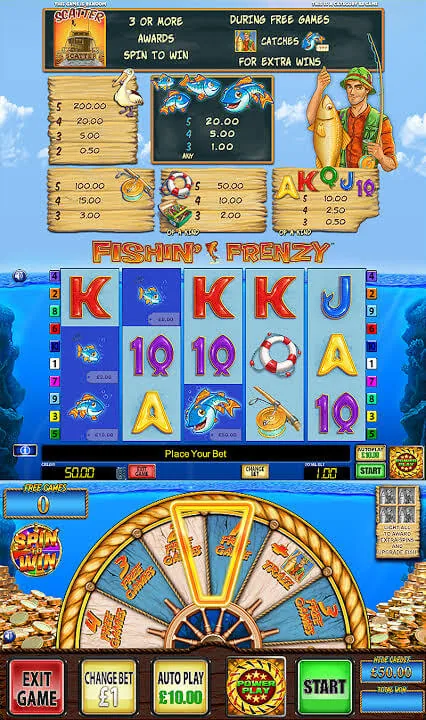
James from Bristol spent three evenings reading conflicting advice about Fishin' Frenzy before he realised the simplest question had no clear answer: what happens when you press spin, and what do the numbers on screen actually mean? He wasn't chasing a system or a secret — he just wanted to understand the game before risking his own money.
Fishin' Frenzy is a 5-reel, 10-payline slot from Blueprint Gaming that became one of the most recognised games on UKGC-licensed sites. The appeal is in the free spins round: land three boat scatter symbols and you trigger 10 free games where a fisherman wild appears and collects the cash values displayed on every fish symbol visible at that moment. Outside the bonus, it's a straightforward base game with low-value playing cards and higher-paying fish, pelican, and boat symbols. The 96.12% RTP sits above the UK average, and medium volatility means you'll see a mix of small wins and dry spells rather than long waits for a single massive payout.
Where the game came from and why it stuck around
Blueprint Gaming released Fishin' Frenzy as a low-key fishing-themed slot, and it quietly built a following on UK casino sites. The premise — a sunny lakeside scene with cartoon fish carrying coin values — had been done before, but Blueprint's version found traction because the mechanic was transparent: you could see the fish values on every spin, and in the bonus round you knew exactly what the fisherman would collect if he landed.
The game's popularity led Blueprint to build an entire series around it. There are now Megaways versions, jackpot variants, and themed spin-offs, but the original 10-line game remains the most played. It's the one you'll find in demo lobbies and the one most guides refer to when they mention Fishin' Frenzy by name.
Blueprint Gaming holds a UKGC licence and supplies games to dozens of British operators. Every site offering Fishin' Frenzy in the UK must display its own UKGC licence number in the footer — that's your first check before you register. If the footer is missing a licence number or points to an offshore regulator, the site is operating illegally in Britain and you should avoid it.
What happens during a single round, step by step
You choose a stake between £0.10 and £100 per spin, though players aged 18–24 are capped at £2 under UKGC rules, and all players face a £5 maximum on any single spin. The 10 paylines are always active, so the stake you set is your total bet for that round — there's no line configuration to adjust.
- You press spin and the five reels stop independently, displaying three rows of symbols.
- The game checks for matching symbols along the 10 fixed paylines, paying left to right from reel one.
- Fish symbols carry visible cash values — £0.20, £0.50, £2.00, and so on — but those values do nothing in the base game. They're only collected during free spins.
- If you land three, four, or five boat scatter symbols anywhere on screen, you trigger 10, 15, or 20 free spins.
- During free spins, a fisherman wild can appear on reels two, three, or four. When he lands, he collects the cash value from every fish symbol visible on screen at that moment, adding the total to your win for that spin.
- The free spins round ends and you return to the base game. Your total win from the round is added to your balance.
The fisherman wild does not substitute for other symbols in the traditional sense — his only job is to gather fish values. If no fish symbols are visible when he lands, he contributes nothing to that spin. That's the mechanic that defines the game: you're waiting for a free spins round where the fisherman and multiple high-value fish appear together.
Stakes, multipliers, and the £25,000 cap explained
The maximum win in Fishin' Frenzy is 5,000× your stake. If you bet £0.50, the top payout is £2,500. At a £5 stake — the legal limit per spin in the UK — the maximum win is £25,000. Blueprint caps the payout at that figure regardless of stake, so even if you were betting above £5 on a non-UK site, the win wouldn't scale beyond £25,000.
The 96.12% RTP means that over millions of spins, the game returns £96.12 for every £100 wagered. That's a long-term theoretical average, not a promise for your session. Medium volatility tells you the game pays out moderately often, but the size of those wins varies — you might see ten small wins in a row, then nothing for twenty spins, then a £50 free spins round. It's less streaky than a high-volatility game, but it's not a steady drip of small returns either.
Fish values during free spins are determined when the reels stop, not when you set your stake. A £0.10 spin and a £5 spin will see the same range of fish values on screen, but the final payout scales with your stake. That's why the demo and real-money versions feel identical in terms of frequency — the RNG doesn't know or care what you're betting.
Where to play legally and what to check before you deposit
Fishin' Frenzy is available at every major UKGC-licensed operator in Britain. You'll find it at Bet365, William Hill, BetVictor, Grosvenor, and dozens of smaller casino brands — these are examples, not endorsements, and you should compare welcome offers, withdrawal speeds, and customer reviews before choosing one.
Before you register, scroll to the footer of the site and look for a UKGC licence number. It's usually displayed alongside the Gambling Commission logo. Copy that number and search for it in the UKGC public register — the register will show the operator's legal name, the licence type (you want «remote» for online casinos), and whether the licence is active. If the number doesn't appear in the register, or if the site displays no licence number at all, it's not legal to use in the UK.
| What to check | Why it matters | Where to find it | |
|---|---|---|---|
| UKGC licence number | Confirms the operator is legal in the UK | Footer of every page, cross-check in UKGC register | → |
| Stake limits by age | £5 per spin for all players, £2 for ages 18–24 | Account settings or responsible gambling page | → |
| Payment methods | Only debit cards, e-wallets, and Open Banking — no credit cards | Deposit page before you register | → |
| Affordability checks | Triggered from £150 net deposits per month | Account verification section | → |
| GAMSTOP registration | Self-exclusion that blocks every UKGC site for 6 months to 5 years | GAMSTOP.co.uk | → |
Credit cards have been banned for gambling in the UK since 2020, so you'll deposit using a Visa or Mastercard debit card, PayPal, Apple Pay, Trustly, or paysafecard. The payment method must be in your own name — operators run automated checks and will freeze your account if the name doesn't match. Most sites complete KYC (age and identity verification) before your first deposit, but some wait until your first withdrawal. Either way, expect to upload a photo ID and a recent utility bill or bank statement.
Withdrawals to e-wallets like PayPal clear in a few hours to 24 hours. Faster Payments to a UK bank account take the same day to two working days. Debit card withdrawals are slower — one to three working days is normal. Your first withdrawal will take longer because the operator manually reviews your documents; 24 to 48 hours is standard, though some sites stretch it to 72 hours.
Demo mode: what it shows you and what it hides
Most UKGC-licensed sites offer a demo version of Fishin' Frenzy, though many require you to log in and verify your age before the demo appears. The demo uses the same RNG, the same RTP, and the same reel strips as the real-money game — the math is identical, and you'll trigger free spins at the same frequency.
What the demo doesn't show you is the emotional weight of real money. A dead spin in demo mode costs nothing and you click through without thinking. A dead spin at £2 per round starts to matter after twenty in a row. The demo also hides the friction of deposits, withdrawals, and waiting for KYC checks — all the small delays that shape how you actually play.
Use the demo to learn the interface: where the stake buttons sit, how the paytable opens, what the autoplay settings do. Once you understand the flow of a round and you've seen a few free spins triggers, you've learned what the demo can teach you. The rest — how you react to variance, whether you stop after a win, how you handle a losing streak — only happens when your own money is at stake.
Mistakes new players make and a short glossary
The most common error is misunderstanding what the fish values mean in the base game. New players see a screen full of fish showing £2.00 and £5.00 and assume they've won that total, but those values only pay out if the fisherman wild lands during free spins. In the base game, fish symbols pay according to the paytable — usually 5×, 10×, or 20× your line bet for three, four, or five on a line — and the displayed cash value is ignored.
Another mistake is chasing a bonus round because the last one paid well. Free spins are triggered by the RNG, and the game has no memory of your previous session. If you've gone 200 spins without a bonus, the 201st spin has the same chance of triggering one as the first spin of the day. There's no cycle, no pattern, and no point where the game «owes» you a feature.
- RTP (Return to Player): the percentage of all wagers the game returns to players over the long term. Fishin' Frenzy's 96.12% is above the UK average, but it's not a guarantee for your session.
- Volatility: a measure of risk and payout frequency. Medium volatility means moderate swings — you'll see wins often enough to stay engaged, but losing streaks of 20 to 30 spins are normal.
- Scatter: the boat symbol that triggers free spins. It pays regardless of where it lands on the reels, as long as you get three or more in view.
- Fisherman wild: appears only during free spins and collects the cash value from every fish symbol on screen. He doesn't substitute for other symbols to complete paylines.
- Max win: the highest possible payout in a single round, expressed as a multiplier of your stake. For Fishin' Frenzy it's 5,000×, capped at £25,000 in the UK.
- Paytable: the screen that shows what each symbol pays for three, four, or five of a kind, and how the bonus features work. Open it before your first spin.
Set a deposit limit before you start. Every UKGC-licensed site must offer daily, weekly, and monthly limits, and many allow you to set a loss limit or a session time reminder. Affordability checks now start from £150 net deposits per month — the operator will request payslips or bank statements using credit-reference data at the first stage, and if you can't evidence the income, your deposit limit will be restricted. If you need to step back, register with GAMSTOP — one sign-up blocks every licensed site in the UK for a minimum of six months. Gambling winnings are tax-free in Britain, though operators pay 40% Remote Gaming Duty on gross profits.
FAQ
Can I play Fishin' Frenzy for free without registering?
Some UKGC-licensed sites allow guest demo play, but most now require you to log in and verify your age before the demo appears. The demo uses the same RNG and RTP as the real-money game, so the frequency of wins and bonuses will be identical. You won't need to deposit to try it, but you will need to prove you're over 18.
Why is my stake capped at £2 per spin when the game allows £5?
UKGC rules introduced a £2 stake cap for players aged 18 to 24 on all slots. If you're in that age bracket, the operator will restrict your maximum bet automatically based on the date of birth you provided during registration. The £5 cap applies to players aged 25 and over. You can't override this — it's a regulatory requirement, not a site policy.
How long does the first withdrawal take, and why do I need to upload documents?
Your first withdrawal from any UKGC-licensed site will be held for KYC checks — the operator needs to verify your identity and confirm the payment method is in your own name. You'll upload a photo ID (passport or driving licence) and proof of address (a recent bank statement or utility bill). Most sites process this within 24 to 48 hours, after which your withdrawal will proceed. Subsequent withdrawals are faster, usually clearing to e-wallets in a few hours or to your bank via Faster Payments within two working days.